
Bailey Uttich
From campus greenhouse to community impact: a Loyola graduate’s path in urban agriculture
Originally from Dallas, Texas, Bailey Uttich chose Loyola for her undergraduate education after falling in love with the campus during a college tour. She appreciated that fact the Loyola offers a traditional college campus nestled within a major city. Uttich initially applied as a nursing major, but her growing concern about the direction of US climate policy inspired her to pivot to environmental sustainability. She graduated in 2024 with a BA in environmental studies and minors in studio art and Spanish language.
Today, Uttich works as the aquaponics coordinator at Windy City Harvest, the Chicago Botanic Garden’s urban agriculture program serving the South and West sides of Chicago. She shared her thoughts about her career path and her experience at Loyola.
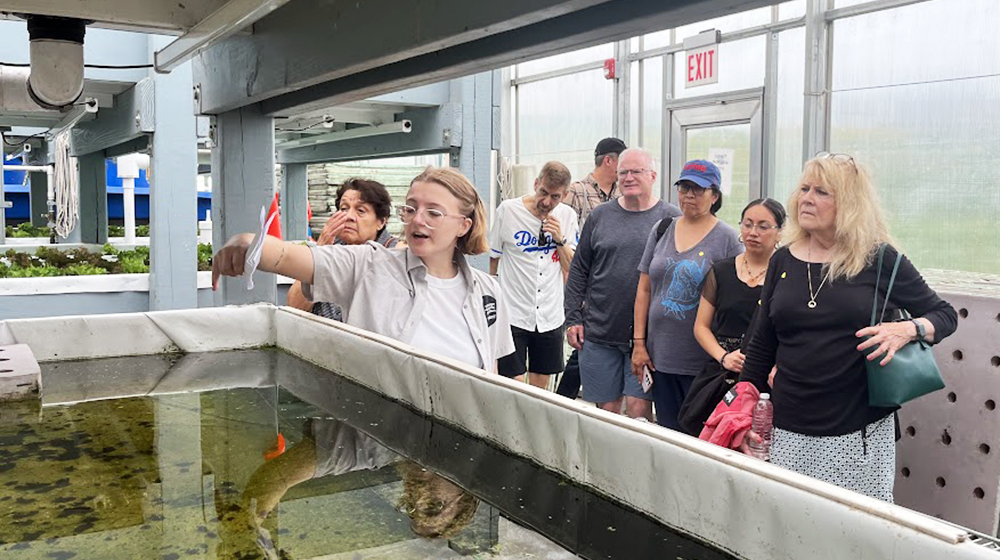
In her role at Windy City Harvest, Bailey Uttich (second from the left) leads tours of the aquaponics greenhouse at the Farm on Ogden. She recently led a tour for visitors from the Chicago Architecture Center and the Chicago Council on Science and Technology (C2ST).
How has your career developed since graduating from Loyola?
Since graduating, I have held two jobs that both greatly depended on the skills I got working in Loyola's Urban Agriculture (Urban Ag) program. Immediately after graduation, I began working in a small greenhouse dedicated to growing garnishes for a local restaurant and catering company. Then, in the fall of last year, I was hired as the aquaponics coordinator at Windy City Harvest, where I still work.
What type of work do you do in your current job?
The work I do now at Windy City Harvest is very similar to the mission of the Loyola Urban Ag program, which is to grow food sustainably and locally. The aquaponics system I operate here is just one small part of all the produce that is grown and distributed at Windy City. We have an in-house grocery store that is very affordable, which is essential in the food desert where we operate.
We also offer other incredible programs that make me feel like the work I am doing actually benefits the community I work in. These notable programs include two job training pathways (corps and apprenticeship), therapeutic horticulture, and VeggieRX. VeggieRx is a prescription produce box program made possible through a partnership between the Chicago Botanic Garden and Lawndale Christian Health Center. Program participants are community members who are combating diet-related illnesses such as diabetes and high blood pressure. Every week, there are two pick-up days where participants can collect their fresh produce boxes, which occasionally contain aquaponic lettuce or a voucher for the in-house store.
In addition, I interact with participants in the corps and apprenticeship program, who assist with aquaponic harvests, cleaning, and transplanting. Getting to teach people who are also interested in agriculture is something I loved in Loyola's urban ag program and have continued to enjoy at Windy City.
How did your experience at Loyola influence your career interests or goals?
I would not be where I am today without my experiences in Loyola's Urban Agriculture program, where I served as the hydroponics team leader and later as the greenhouse manager. Until I started urban agriculture, I never imagined I would actively seek employment outdoors, as the growing season where I grew up, in Dallas, was tremendously hot and miserable. Working as an intern in the Winthrop Garden in the fall of 2022 was a truly life-changing experience for me.
My time at Loyola also influenced my career goals as I became more aware of the science behind climate change and the societal implications of climate policy, particularly how these issues primarily impact communities of color.
I still think about what a valuable experience it was when Kevin Erickson, the manager of Loyola's Urban Agriculture program, allowed me and my coworkers to decide on the farmer’s market where we would sell our produce. We knew we would make higher profits if we continued selling at the Glenwood Farmers Market. However, after a season of selling at the Edgewater Farmers Market, we found that we made less money but had much higher rates of LINK/SNAP card swipes. We decided to stay at the Edgewater Market because it was serving a demographic of people with a greater need for access to affordable, fresh produce.
How did your education in SES prepare you to work in your chosen field?
Aside from the technical experience I gained through participating in the Urban Ag program for two years, every single class I took at SES provided me with helpful information that I still use to this day. I recall learning about bioaccumulation in my Introduction to Environmental Science classes with Dr. Laura Brentner. That concept is critical when working with fish that community members will consume. In Kevin Erickson's sustainable agriculture class, I learned that the nutrient density of a food crop decreases the longer it is stored on a shelf or in transit, which is highly relevant to my current work. Other classes that I loved and still find essential to my work and everyday life are Climate Change with Ping Jing, Ecology with Fr. Mitten, Human Dimensions of Conservation with Tania Schusler, Intro to Environmental Law and Policy with Gilbert Michaud, and Conservation Biology with Brian Ohsowski.
What are some of your highlights from your time at Loyola?
I loved working in the most beautiful building on campus! Spending time every day in the greenhouse with some of my closest friends will forever be my favorite part of my Loyola experience. The community I found in the Urban Ag program cannot be understated. When I first started college as a freshman in 2020, I was lost and definitely struggled to make friends. That changed once I joined the urban ag program. The classes I took were also a big highlight. I looked forward to class selection every semester because I couldn't wait to discover what else I would learn from the amazing faculty at SES.
What advice would you give to current or prospective SES students?
I would advise current students to try something they never thought they might enjoy, such as the Urban Ag program, the Restoration Club, or the Student Environmental Alliance. I promise you can find the right community, just as I did! I'm still close with some of my Loyola Urban Ag friends, and I even work with one of them at Windy City, which has been a dream come true!
September 2025
How has your career developed since graduating from Loyola?
Since graduating, I have held two jobs that both greatly depended on the skills I got working in Loyola's Urban Agriculture (Urban Ag) program. Immediately after graduation, I began working in a small greenhouse dedicated to growing garnishes for a local restaurant and catering company. Then, in the fall of last year, I was hired as the aquaponics coordinator at Windy City Harvest, where I still work.
What type of work do you do in your current job?
The work I do now at Windy City Harvest is very similar to the mission of the Loyola Urban Ag program, which is to grow food sustainably and locally. The aquaponics system I operate here is just one small part of all the produce that is grown and distributed at Windy City. We have an in-house grocery store that is very affordable, which is essential in the food desert where we operate.
We also offer other incredible programs that make me feel like the work I am doing actually benefits the community I work in. These notable programs include two job training pathways (corps and apprenticeship), therapeutic horticulture, and VeggieRX. VeggieRx is a prescription produce box program made possible through a partnership between the Chicago Botanic Garden and Lawndale Christian Health Center. Program participants are community members who are combating diet-related illnesses such as diabetes and high blood pressure. Every week, there are two pick-up days where participants can collect their fresh produce boxes, which occasionally contain aquaponic lettuce or a voucher for the in-house store.
In addition, I interact with participants in the corps and apprenticeship program, who assist with aquaponic harvests, cleaning, and transplanting. Getting to teach people who are also interested in agriculture is something I loved in Loyola's urban ag program and have continued to enjoy at Windy City.
How did your experience at Loyola influence your career interests or goals?
I would not be where I am today without my experiences in Loyola's Urban Agriculture program, where I served as the hydroponics team leader and later as the greenhouse manager. Until I started urban agriculture, I never imagined I would actively seek employment outdoors, as the growing season where I grew up, in Dallas, was tremendously hot and miserable. Working as an intern in the Winthrop Garden in the fall of 2022 was a truly life-changing experience for me.
My time at Loyola also influenced my career goals as I became more aware of the science behind climate change and the societal implications of climate policy, particularly how these issues primarily impact communities of color.
I still think about what a valuable experience it was when Kevin Erickson, the manager of Loyola's Urban Agriculture program, allowed me and my coworkers to decide on the farmer’s market where we would sell our produce. We knew we would make higher profits if we continued selling at the Glenwood Farmers Market. However, after a season of selling at the Edgewater Farmers Market, we found that we made less money but had much higher rates of LINK/SNAP card swipes. We decided to stay at the Edgewater Market because it was serving a demographic of people with a greater need for access to affordable, fresh produce.
How did your education in SES prepare you to work in your chosen field?
Aside from the technical experience I gained through participating in the Urban Ag program for two years, every single class I took at SES provided me with helpful information that I still use to this day. I recall learning about bioaccumulation in my Introduction to Environmental Science classes with Dr. Laura Brentner. That concept is critical when working with fish that community members will consume. In Kevin Erickson's sustainable agriculture class, I learned that the nutrient density of a food crop decreases the longer it is stored on a shelf or in transit, which is highly relevant to my current work. Other classes that I loved and still find essential to my work and everyday life are Climate Change with Ping Jing, Ecology with Fr. Mitten, Human Dimensions of Conservation with Tania Schusler, Intro to Environmental Law and Policy with Gilbert Michaud, and Conservation Biology with Brian Ohsowski.
What are some of your highlights from your time at Loyola?
I loved working in the most beautiful building on campus! Spending time every day in the greenhouse with some of my closest friends will forever be my favorite part of my Loyola experience. The community I found in the Urban Ag program cannot be understated. When I first started college as a freshman in 2020, I was lost and definitely struggled to make friends. That changed once I joined the urban ag program. The classes I took were also a big highlight. I looked forward to class selection every semester because I couldn't wait to discover what else I would learn from the amazing faculty at SES.
What advice would you give to current or prospective SES students?
I would advise current students to try something they never thought they might enjoy, such as the Urban Ag program, the Restoration Club, or the Student Environmental Alliance. I promise you can find the right community, just as I did! I'm still close with some of my Loyola Urban Ag friends, and I even work with one of them at Windy City, which has been a dream come true!
September 2025